Posts

Showing posts with the label technology resources

Do No Harm

Image
Photo Credit: Lauren Johnson If you are a math teacher, perhaps you have heard of Desmos . They make an amazingly powerful, free, online graphing calculator as well as awesome math activities . Over the past few years, in pursuit of learning more about what teachers need as well as to build a network, they have developed a “Desmos Fellowship” program where about 40 teachers are brought to their headquarters in San Francisco for a weekend of collaboration and learning.  There have been 3 cohorts of teachers to be involved in the Desmos Fellows program. The popularity of the program growing so much that there were over 400 teachers to apply for Cohort 3 that just met this past weekend. I was very humbled and honored to be part of the group. If you ever have heard the saying, “if you are the smartest person in the room, you are in the wrong room,” just know if that is true, I was most definitely in the right room, as I was overwhelmed by the amount of people so much smarte...

STEM Themed Toys, Gifts, and Prizes

Image
My district hosts a student-centered conference called SIT (Students Involved with Technology) . It's a great event where students present their knowledge of tech to other students. It's held on a Saturday and open to kids in grades 3-12. There are students from our district and also kids from surrounding areas. There is even a kid keynote! Generally our biggest issue is kids running in the hallways... because they are so excited to get to the next session! The adults just help kids get set up and are there to supervise, but it's the students that present and learn from each other! Each year we cap off the day with raffle prizes. This year I was asked to make an Amazon wish-list of prize ideas. So, basically, I got to shop for $900 worth of fun stuff! I tried to get prizes that would appeal to kids that range from 8 years old to seniors in high school. I also put some artsy stuff on there, some coding stuff, books, toys, and t-shirts. Who do you think is ...

Desmos in Elementary!

Image
If you are an elementary teacher, the tool Desmos Activity Builder might be new to you. While I see most current activities for middle and high school, don't let this deter you from giving it a try! There are some interesting and powerful ways to leverage this digital activity builder for you classroom. I've started making a few activities myself! Some of the best things about Desmos is that you can use it on any device, it's free, the teacher dashboard/controls are awesome, and the activities you can build let you see student thinking in the moment! (Check out my blog post about 9 criteria to see how I judge formative assessment tech tools .) I made a few screencast videos to help you get started and get some ideas of how you might use this in your K-5 classroom: Getting started and adding card sorts to your activity options: Adding a card sort to your activity: Teacher Dashboard and Controls: The power of sketch and sketch overlay:

Criteria for Choosing Tech Tools

Image
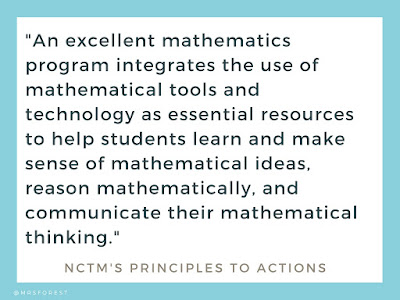
I LOVE USING TECH TOOLS. Let me be clear that I don't like using tech just for tech's sake. Instruction first. Always. Also, focus on the learning. I heard someone say "there is no app for good pedagogy." So true. So, with all those disclaimers, why do I love using technology? Well, it's important, relevant, and honestly can redefine your classroom and the learning for students. I love this quote from NCTM's Principles to Actions : The word essential really stands out to me in this quote. Technology isn't something you can ignore or deny. It's an essential part of our students' world and we need to embrace that. But we all know that there is amazing tech tools and some not-so-great stuff out there. How can you decide what to use? When it comes to using technology in the math classroom, I find using it for students to do practice/formative assessment is most powerful. If I can see their thinking, in the moment, and give feedback it ca...

Math Friends Ask: What is ISTE?

Image
I went to ISTE last week and I felt like I was cheating on my math friends. WHAT IS ISTE? First, ISTE stands for International Society for Technology in Education. They have a big annual conference every summer. This year it was in San Antonio and I was lucky enough to get to present and attend. If you have never heard of ISTE, you aren't alone. Despite the fact that this conference is HUGE, many educators don't even know it exists. (I didn't until a few years ago.) And I saw on Twitter a few math educator friends asking what #ISTE17 stood for because they were seeing it in their newsfeed. And, to make it even harder, I looked at ISTE's website and had to dig a bit to even find it all spelled out! So, why hadn't I heard of ISTE until recently? I've connected mostly with the math ed crowd on social media and engage with the fine folks in #MTBoS often. I just don't hear much about tech stuff as it relates to math... with the big exception being fo...

Using Desmos with Primary Students!

Image
Like so many math teachers , I LOVE Desmos! I tell everyone who will listen that they should be using it. I used it myself when I was in the classroom teaching middle schoolers. The graphing calculator is such a fabulous tool and the Desmos created activities are so engaging and awesome. As I've learned more about activity builder and moved into a K-8 instructional coaching role, I started to think about how it could be used in younger grades. I love the power of card sorts for all levels, so having that option in Desmos really sets it apart from some other platforms that teachers might already be using like ClassKick and Formative (which I love as well!). Recently, I was asked to model a few lessons in classrooms. I started in a 5th grade classroom, and it seemed like a good fit to use Desmos as part of an activity. I included a card sort as well as some open response questions. It went well! Next, I was headed to a 1st grade classroom. They were learning ...

1 Second Everyday

Image
My new app obsession is  1 Second Everyday . The idea is to take 1 second of video each day and compile it into a video. I first purchased the app for my iPhone with the idea of capturing video of my kids. I've been doing it and it's great!! When you put all the clips together it tells such a great story. The app is very easy to use. You can use video saved from your camera roll or you can record video within the app. It is also a cinch to watch, select, and crop your 1-second of footage to use. Finally, you just hit play and the app puts all the 1-second pieces together. Easy-peesy! A few weeks ago, I started thinking about how I might use the app in school. With a $4.99 price tag, it probably isn't feasible to purchase for students and have them creating their own 1 Second Everyday compilations. However, as a classroom teacher, how amazing would it be if you captured just one second from each day of the school year and at the end of the year you had an ...

New School Year, New Opportunities

Image
My professional life has been full of changes. I thought I would take a post to talk about what I've been up to! Illinois Council of Teachers of Mathematics I remember years ago, as a second year teacher, I turned to the ICTM webpage for some ideas for Pi Day. While looking around, I noticed they had awards and thought it would be so amazing to be honored with a teaching award some day. In 2014, I was lucky enough to fulfill that dream . Getting more involved with ICTM by presenting at the annual conference, managing the Facebook page, and then accepting the award made me think about becoming a board member. Again, I thought it would be so amazing to be able to contribute more widely to the math education community and this would be a great way. I am honored that I was elected to serve as Director of grades 5-8 on the Board of Directors. Recap Pioneer Another opportunity that I'm excited about is being a Recap Pioneer . I started using this tech tool in my ...

Ideas for Differentiation in Math Class

Image
Differentiation. I probably don't need to say this, because you already know, but I want to acknowledge just how tricky differentiation can be. There are several reasons: 1. Different kids need different things 2. Different kids like different things 3. Not everyone has the same background knowledge 4. Everyone has different misconceptions or misunderstandings With all of these factors, in each kid, there is actually no way that two kids can be alike! Each kid is unique in their way or learning and seeing the world! There are infinite combinations in how those above factors play out in kids brains. How amazing ! But also, how hard  for teachers! No two kids are alike, but somehow we are supposed to differentiate?? Teachers ask me all the time, "Annie, I know you aren't a fan of tracking , but then how do we reach our top kids? Or struggling kids?" Here's the thing, even if we did have "tracking" and kids were perfectly placed...

Free Apps I Use in the Math Classroom

Image
There are SO many great ways to use iPads in the classroom. However, it can be a little overwhelming! Last year was my first year using iPads in math class. I tried a lot and learned a lot along the way. One big lesson I learned is that there are many math "games" out there that aren't much more than digital flashcards. In addition, many are timed which I think adds a lot of stress and not much in the way of getting students to think mathematically.  Read Tracy Zager's criteria for fact-based apps . If you are new to iPads, or just looking for some new apps, wanted to share some of my favorites. Many of the best apps I found are free! First, if you teach middle school or high school, you NEED Desmos . Download it now and read more about Sara's love of Desmos . Although the activities aren't through the app, also take some time to check out the activities at teacher.desmos.com . Next, check out ClassKick . You create assignments, kids work, yo...

3 Things

Image
Twitter: 1. Following along with the NCSM Annual Meeting (#NCSM16) and the NCTM Annual Meeting (#NCTMannual) and all of my tweeps attending (#MTBoS). Feeling super jealous that I can't be there, but making the best of learning from afar! 2. Trying out using a Twitter chat format in my classroom. As a warm-up I post three questions on the board using the format Q1, Q2, and Q3. Then I ask students to fill out our Twitter google doc with their response to a chosen question using A1, A2, or A3. They also include the hashtag: #6Amathchat. I then curate answers and post to our class Twitter account ( @6Amath ). It's a great, quick formative assessment! 3. Continuing on my journey thinking about how I can be more culturally responsive. I've been reading a lot about white privilege and white silence in education. I'm following #educolor and a few people that have really pushed my thinking: Jose Vilson ( @TheJLV ), Rusul Alrubail ( @RusulAlrubail ), and Greg Curra...