Posts

Showing posts with the label replacing tricks with understanding

My Favorite Fraction Manipulative
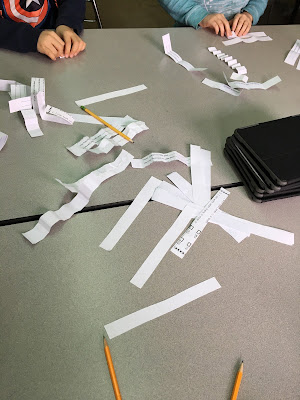
Image
Wait, that just looks like strips of paper ?! Yep, that's what it is. Introducing my FAVORITE fraction manipulative. No need for fancy plastic fraction tiles, no purchase order necessary, no app to download. Just find some paper and cut it in strips. It can even be "GOOSe" paper (good on one side), as in scrap paper ! Here's why I love it: 1) It makes fractions visual . 2) It relates to tape diagrams. 3) It helps make connections of where fractions go on the number line. 4) It's a manipulative that won't expire. It always works, even when students start exploring decimals and percents. 5) It's fun! I have done this lesson with lots of kids over the years. It works great with grades 4-6.  Here's the procedure: 1) Put a lot of strips of paper out! (you want kids to have access to extra in case they "mess up") 2) Have students start with 1 strip and fold into halves. This is usually accessible for ...

Small Changes that Make a Big Impact!

Image
I love the NCTM article, Never Say Anything A Kid Can Say,  by Steven Reinhart. I reread it often and it always reminds me of something to work on or try so that I can have a more student-centered math class. I have recently been sharing 3 of my favorite tips from the article at PD in my district. These three tips are small changes that you can make that have a BIG impact on your classroom. I vlogged about those three ideas. Enjoy! ;)

Ideas for Differentiation in Math Class

Image
Differentiation. I probably don't need to say this, because you already know, but I want to acknowledge just how tricky differentiation can be. There are several reasons: 1. Different kids need different things 2. Different kids like different things 3. Not everyone has the same background knowledge 4. Everyone has different misconceptions or misunderstandings With all of these factors, in each kid, there is actually no way that two kids can be alike! Each kid is unique in their way or learning and seeing the world! There are infinite combinations in how those above factors play out in kids brains. How amazing ! But also, how hard  for teachers! No two kids are alike, but somehow we are supposed to differentiate?? Teachers ask me all the time, "Annie, I know you aren't a fan of tracking , but then how do we reach our top kids? Or struggling kids?" Here's the thing, even if we did have "tracking" and kids were perfectly placed...

Why I Don't Use Keywords (or CUBES)

Image
Teacher confession time: I used to teach my students about keywords in math class. I did not create this poster, but I could have. In fact I had one very similar hanging in my classroom from 2007-2012. I even wrote one of my National Board portfolio entries about a lesson designed around keywords ! This brings be to CUBES. A problem solving strategy I've seen quite a few times in classrooms. I never used it, but mostly because I didn't hear about it. I probably would have been all over that. If you aren't familiar, here is the strategy: C- circle the numbers U- underline the question B- box the keywords, or math action words E- evaluate the steps you should take S- solve and check You might be wondering why I stopped using keywords in math class in 2012. Honestly, I was pretty stubborn. I mean, kids  got the right answers  when I taught key words! I thought I was helping them. Students liked them. Parents understood them. There are actually several reasons I...