Posts

Showing posts with the label equity

The Low Kids and The High Kids

Image
Teaching is challenging and personal and important work. Every teacher I work with is doing their best, want to do their best, and do all of this with a kind teacher heart. I love teachers, in fact I still identify as a teacher myself. When people ask what I do, I say I'm a teacher. Because even if I'm a coach or a math coordinator, at the center of my work is teaching. I was in the classroom for 12 years. I know the difficulties of having a diverse group of learners in one class. The range of understanding on any given topic can be overwhelming to navigate. Am I challenging everyone enough? Is this too challenging? Are kids bored? Are kids checked-out? Are they learning? These are real questions and fears we all have. And sometimes, being in this work means we develop some short-cut ways of describing the complexity of what we see in front of us. It's normal and natural as humans to look for patterns in our experience and categorize things. If we didn't our br...

Responsible Data

Image
I think data is important. I even recently presented about " Data Driven Coachin g" at ISTE! I've been thinking a lot about how we use data to tell a story and the implications it has for teachers and our students. One thing that really gets me upset is when I see data being reported (usually visually) in misleading ways. Sometimes I think people just don't realize that they are creating something misleading, while other times things are done to intentionally exaggerate what is actually going on. This TED-Ed video explains this really well: So when I came across this tweet, I immediately looked at the y-axis. I noticed that the % was "zoomed in" making it look like engagement in high school was practically 0%, even though it was 44%. Now, 44% isn't great. And the overall trend of declining engagement is worrisome. But, the math teacher in me was just a little annoyed at the misleading graph. This is OUR problem. We must do something to combat...

Ideas for Differentiation in Math Class

Image
Differentiation. I probably don't need to say this, because you already know, but I want to acknowledge just how tricky differentiation can be. There are several reasons: 1. Different kids need different things 2. Different kids like different things 3. Not everyone has the same background knowledge 4. Everyone has different misconceptions or misunderstandings With all of these factors, in each kid, there is actually no way that two kids can be alike! Each kid is unique in their way or learning and seeing the world! There are infinite combinations in how those above factors play out in kids brains. How amazing ! But also, how hard  for teachers! No two kids are alike, but somehow we are supposed to differentiate?? Teachers ask me all the time, "Annie, I know you aren't a fan of tracking , but then how do we reach our top kids? Or struggling kids?" Here's the thing, even if we did have "tracking" and kids were perfectly placed...

In Response to #iwishmyteacherknew

There are a ton of tweets with the hashtag #iwishmyteacherknew. The idea is, as a teacher, you ask your class what they wish you knew and you collect their responses. This idea is not new. I remember hearing about it two year ago. But, with the beginning of a new school year, it's come back around. Oh, and there is a teacher making money off of it, too. What?! Making money, you might ask? Yes, a teacher asked her class this question and turned the responses into a book (not linking to it, on purpose). Now, I'm all for writing about the profession. I have a stack of edu books waiting to be read. What I'm not into is asking kids to share their deepest thoughts, fears, and struggles and then turning around and sharing them with the world. Rafranz Davis says it great, read her post here . You are their teacher. If they feel safe enough with you to share personal details, DO: 1. read it 2. let it inform you as a teacher 3. and keep it private! DON'T: -share on ...

When to talk, when to listen

Image
I woke up Tuesday morning and held my newest baby, Dean. I checked my phone, as I often do in the morning and looked at Twitter. A few people were sharing how upset they were and including the hashtag #AltonSterling. Another black man shot and killed by a white police officer . The fact that I just started that previous sentence with the word "another" speaks for itself. How are these occurrences becoming so common place? Yesterday I woke up, similar to Tuesday, and somehow there is ANOTHER story of a black man being shot and killed by police  (#PhilandoCastile). I sat staring at my phone for a while. I wanted to tweet and express my outrage. I wanted to convey how upset this made me. Here I am with a white husband that can go to work this morning with little no worry that he will be shot by police. I have a white son that, because of his skin color, is afforded a privilege that he did nothing to earn .  Today I woke up reading articles and comments in response t...

3 Things

Image
Twitter: 1. Following along with the NCSM Annual Meeting (#NCSM16) and the NCTM Annual Meeting (#NCTMannual) and all of my tweeps attending (#MTBoS). Feeling super jealous that I can't be there, but making the best of learning from afar! 2. Trying out using a Twitter chat format in my classroom. As a warm-up I post three questions on the board using the format Q1, Q2, and Q3. Then I ask students to fill out our Twitter google doc with their response to a chosen question using A1, A2, or A3. They also include the hashtag: #6Amathchat. I then curate answers and post to our class Twitter account ( @6Amath ). It's a great, quick formative assessment! 3. Continuing on my journey thinking about how I can be more culturally responsive. I've been reading a lot about white privilege and white silence in education. I'm following #educolor and a few people that have really pushed my thinking: Jose Vilson ( @TheJLV ), Rusul Alrubail ( @RusulAlrubail ), and Greg Curra...

In Anticipation of Hour of Code

Image
This will be my third year having my students participate in the Hour of Code . ( year 1 , more year 1 , year 2 ) If you haven't heard of this initiative before, basically, it is a week dedicated to getting students at least 1 hour of coding in school. Most schools, including mine, do not teach computer science (CS) or computer programming (coding). In addition, there is a lack of diversity in professions that use CS. Female students and students of color are underrepresented in the field.  Hour of Code aims to give students an opportunity to learn about coding and to improve diversity in CS. One of my goals this year is to get my students to see math as a creative subject. Many people naturally see art, music, or even english-language arts as creative subject, but have a hard time imagining what is so creative about mathematics. A few ways I'm addressing this goal are getting my students to think creatively using lots of the #MTBoS resources or even just creating prod...

Closing the Gap

Image
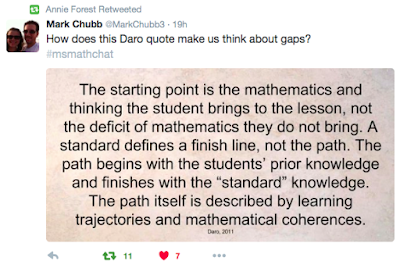
This Tweet is the inspiration for this post. This quote by Phil Daro , and tweeted by my tweep Mark Chubb ,  really speaks to my current feelings about how to help struggling math students. My district is using MAP testing and learning how to use the data best. I think many teachers and administrators are happy to have some specific data on students. However, I don't think teachers found the data particularly surprising... students that struggle tended to have a lower score and students that excel tended to have a higher score. The difference in the data from MAP testing compared to other testing we have done, is that the results come back with individual "plans" for students on what they "can do" and what they are "ready to learn next." This seems exciting to some and, for some reason, makes me pause. I, too, would love a prescription for what to do with students that struggle. Some teachers suggest that we have students watch Khan...

Things I've Stopped Doing

Image
After reading Cult of Pedagogy's blog post about teaching practices she is "kicking to the curb," I was inspired to write a post in the same style and address practices that I don't do anymore. Putting a Grade at the Top of the Paper In the past, I might spend hours grading a test, giving comments in the margin, and then carefully counting up correct answers and putting a grade at the top of the paper. If I was feeling extra nice, I might even put a sticker. Then, when I passed back the papers, I would be so annoyed that students just looked at the grade, ripped the sticker off, and I found most tests in the recycling bin at the end of class. Even my attempts to get students to save the tests in their "portfolio" were lacking in authenticity, because I knew students had only looked at the "grade" and not what they had gotten wrong or any of my comments. Two years ago, I started grading using a  color coding system  and NO GRADE. Whoa, ...

Math Intervention Class?

A blog that I love to follow is Cult of Pedagogy . If you have never visited it, I suggest you check it out soon! So much great stuff about classroom culture, teaching, and, well, pedagogy! :) Recently, I saw on Twitter that Jennifer (@cultofpedagogy) was asking for feedback from math teachers about a question from a parent. Interested to see what the question was, I clicked over to find this question posed: A student was recommended for a math "reinforcement" class. The student wasn't happy to be missing an elective with friends. The parent wanted to know what to do. There are several things to consider. I wrote a comment on the blog and included it below for you to read. I would love to hear how other math teachers would answer this tricky question! My comment: First, how great that the parent is considering their child’s feeling in the decision. Many times I see adults making decisions for kids and ignoring their feelings in that process. As for the math “re...

Graph of the Week

Image
I came across a tweet from  @mathsjem  where she shared the link to her blog post about 5 teaching ideas . I'm super excited about one, especially, called "Graph of the Week."  (<-- seriously, check out this, lots of resources!) The idea is to pose a graph to students and have them answer questions/ reflect on the graph. It is such an important skill for life! I'm thinking that I will talk with the Science and Social Studies teachers on my team to get the graphs or at least topics for the graphs so students can start making connections between different subjects. In fact, besides graphs, I might also include info graphics, as that is how students are also seeing information presented to them. Looking forward to this new idea and will blog in the future to let you know how it goes!

Ban Bossy?

Image
When I create a presentation about the topics of math discourse or collaborative learning, I usually include a slide about, what I call, "kind reminders." In my classroom, I expect groups to handle minor issues as a group. If someone isn't contributing or if they are being annoying (I teach middle school, so this comes up often!), I want them to address the group member in a respectful way. I believe this helps students have ownership over their group, find ways to resolve conflict, and it also frees me up, as a teacher, to help groups with the  math  instead of having to address misbehaviors. The slide that I made to share with students is a t-chart showing what group members should address and what I will address. I recently edited the slide with a line to cross out the word bossy. The slide now looks like this: So, why did I cross out the word "bossy"??? I've been doing some thinking about this lately after reading a few things t...

IL State Finalist for PAEMST

Image
Although I found this out a few weeks ago, today the official email went out announcing that I am a finalist for Illinois Presidential Award of Excellence in Mathematics and Science Teaching! I wanted to record a little bit about the application process, both for myself and for anyone that is thinking about applying for the award. The process started by being nominated by a math coach, Sendhil Revuluri. I have to admit that when he nominated me, I was flattered, but I really wasn't thinking that I would apply. I had just returned to work from maternity leave and couldn't imagine putting in the work required for the application! After a conversation in the late winter with Sendhil, when he inquired about my application status (um, not even started!), I got to thinking that maybe I could try to put something together. Well, the application process had quite a few pieces. I had to get three letters of recommendation, so I asked my principal, Jim Calabrese, another princip...

Thoughts on Kahoot!

Image
Have you tried this fun and addicting online game called Kahoot ?! Well, it all the rage right now, especially in education technology. You play the game on a device (tablet, computer, or phone). You project the questions on the board and students answer the (multiple choice) questions by clicking on 1 of 4 shapes on their device. Speed and accuracy are rewarded and after each question, a leaderboard is displayed showing where the top players stand. In honor of the ISTE Conference taking place right now, I wanted to take a moment to share my thoughts about Kahoot! as an educational tool. While there are definite positives, I do have a few words of caution that I think are important to consider when deciding how this activity might fit into your lessons. Positives: -It is so fun! Adults and kids alike really enjoy it (including me!!) -Everyone stays engaged, the whole time, even if they aren't "winning" -You can use pre-made questions or make your own -It'...

Wait, what?!

Image
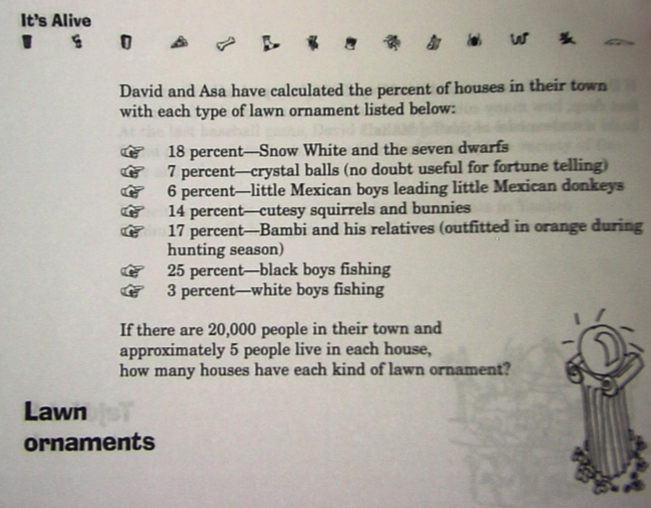
"Wait, what?!" This was my reaction when I read this problem in the book, "It's Alive."  I was so upset by the insensitive racial language in the problem. I decided to write the letter (included below). I found the email address for the publisher and sent off my letter. I was pleased to hear back from the editor and publisher within the day (their letters are below as well). Their quick response showed that they understood the magnitude of the problem and I appreciated their action to revise the problem. This turned out to also be a learning experience for my students as I shared the problem with them, as well as my letter and the two responses. My students had reactions like, "Wow, you got it changed!" and "I didn't realize you could write a letter like that!" I think it was important to share with my students the power of words and why it is important to address injustices when they see it. While I was happy that the publ...