Posts

Showing posts with the label lesson plan

Counting Collections

Image
I LOVE COUNTING COLLECTIONS! I can't believe I didn't know about them before, but after watching an ICTM webinar by Denise Brown ( check out the recording here !), I was hooked! Immediately, I reached out to a few teachers in my district that also watched the webinar. I co-taught a counting collections lesson in each of their classrooms, one kindergarten and the other 1st grade. Wow. It was amazing. Then, I saw another ICTM webinar by Kassia Wedekind ( see that one here !) where she talked about nudges during counting collections. Ah ha! Another amazing idea. Now I wanted to try more counting collections lessons. Luckily, we had a teacher institute day coming up and one of the original counting collections teachers agreed to present the idea to all of the kindergarten and 1st grade teachers. She did an awesome job sharing how she was using the routine in her classroom. Next, I put together a traveling "Counting Collection Collection." I went to the dollar...
My Favorite Fraction Manipulative

Image
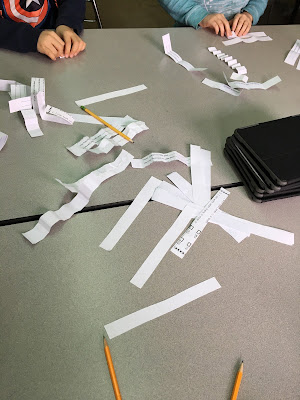
Wait, that just looks like strips of paper ?! Yep, that's what it is. Introducing my FAVORITE fraction manipulative. No need for fancy plastic fraction tiles, no purchase order necessary, no app to download. Just find some paper and cut it in strips. It can even be "GOOSe" paper (good on one side), as in scrap paper ! Here's why I love it: 1) It makes fractions visual . 2) It relates to tape diagrams. 3) It helps make connections of where fractions go on the number line. 4) It's a manipulative that won't expire. It always works, even when students start exploring decimals and percents. 5) It's fun! I have done this lesson with lots of kids over the years. It works great with grades 4-6.  Here's the procedure: 1) Put a lot of strips of paper out! (you want kids to have access to extra in case they "mess up") 2) Have students start with 1 strip and fold into halves. This is usually accessible for ...

Post-It Geometry Challenge

Image
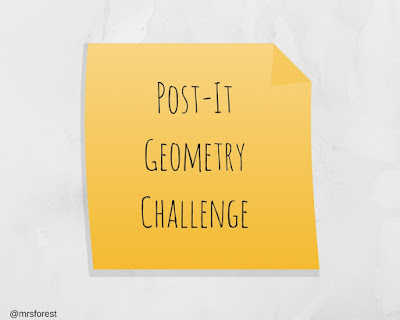
This activity is a fun investigation into symmetry. However, you don't have to wait until you are explicitly teaching geometry or symmetry. It encourages students to be precise and persevere in problem solving. Use it to help address those Standards for Mathematical Practice ! I think 4th grade and up would enjoy a few of these challenges. I've tried it with middle schoolers (6-8) as well as adults. I love the fact that this is an opportunity for all learners to engage in math at the same time. It might even be an opportunity for students that don't find as much success in math class to excel. Here's how it works: 1. Put the picture of the post it notes with holes in it. 2. Students are challenged to take a post-it note and try to fold it so that with 1 single punch with a hole punch it will create this when opened back up. I suggest showing this image first: This one requires a simple fold of the post-it in half.  Walk through how...

60 Minute Math Block Planning

Image
Recently I wrote a post about planning an 90-minute middle school block . Since then, I've been asked to think about ideas for teaching a 60-minute block in elementary school. I came up with 5 ideas for ways to structure 60-minutes of time with 1st-5th grade students. Think of these as recipes. A starting point. Something you can try as is, and then, as you get more comfortable, move around and adapt to your needs and the needs of your students. I don't know if you like to cook, but it is one of my favorite hobbies. I love trying new recipes. For me, I try the recipe as suggested for the first few times. Once I get comfortable, I might substitute in some herbs. Maybe I change out other ingredients or move things around. It's the same idea for these structures! Option 1: This first idea is based on the 5 E's model : Engage, Explore, Explain, Elaborate, Evaluate. I love this model for encouraging exploration and being true to the constructivist philosophy...

Desmos in Elementary!

Image
If you are an elementary teacher, the tool Desmos Activity Builder might be new to you. While I see most current activities for middle and high school, don't let this deter you from giving it a try! There are some interesting and powerful ways to leverage this digital activity builder for you classroom. I've started making a few activities myself! Some of the best things about Desmos is that you can use it on any device, it's free, the teacher dashboard/controls are awesome, and the activities you can build let you see student thinking in the moment! (Check out my blog post about 9 criteria to see how I judge formative assessment tech tools .) I made a few screencast videos to help you get started and get some ideas of how you might use this in your K-5 classroom: Getting started and adding card sorts to your activity options: Adding a card sort to your activity: Teacher Dashboard and Controls: The power of sketch and sketch overlay:

Back to School: What to Change? What to Keep?

Image
IT'S HERE!!! If you are like me, you feel a little sad about the end of summer but also super excited for a new school year. I love the new school supplies, fresh start, classroom decorating , meeting new kids, and a chance to try new things! I wanted to put together a post that compiled all of my favorite past posts related to stuff teachers think about at the start of a new school year. First, I like to sit down and write out my goals . I think about what I want to keep and what I might want to change . There are several things that you might have done in the past that you might want to rethink. For example, grading , getting rid of your teacher desk , or even how you speak about gender in your classroom . How are you going to arrange your classroom? How will you make seating charts that encourage collaboration ? Think about small changes you could make that will have a big impact. Here are a few . Think about how you might want to treat mistakes in your clas...

First Day of School: "Me In Numbers"

Image
One way to introduce yourself to a new group of students is to do "Me In Numbers."* Here's how it works:  1. Make up a few questions about yourself. List the numbers (out of order) at the bottom. Have some easy to figure out and others that could be several of the options. For example, my daughter is probably not 38 or 1884 years old... but she could be 2, 3, or 14.  2. Display to the class and have them right down their guesses for each statement. Each number at the bottom is used once. (sometimes I like to set it up that they are going to have a "quiz" on this first day. I have a smile on my face so they don't get too nervous, and then obviously when I show them they questions they know it's not a graded quiz but just for fun). 3. Go over the answers as they "grade" their work. As you go over the answers, share a bit about yourself. I usually have a slide or two to go with each answer with some pictures of my family, cats...

Kaleidocycles: How To

Image
via GIPHY I started teaching in 2004. That first year, I found a blank net of a "Kaleidocycle" online. Back then, there weren't as many online tutorials! In fact, this one didn't even come with any instructions. So, I sat down with a few copies and started cutting and gluing until I figured it out. I tried it with my 8th grade students and it was a hit! The next year I tried it again with more middle schoolers and, again, everyone loved it. I continued to use it as one of my go-to end-of-the-school-year lessons . So, in total, I believe I have taught over 1000 students how to make Kaleidocycles ! This copy of a copy is the only lesson that I have saved from that first year of teaching and that I have used consistently, every year, since I first started. It really does hold a special place in my teacher heart. So... how do you make it?! First, download the net . I suggest printing it on card stock. I made a little tutorial video to help you get started. ...

Using Desmos with Primary Students!

Image
Like so many math teachers , I LOVE Desmos! I tell everyone who will listen that they should be using it. I used it myself when I was in the classroom teaching middle schoolers. The graphing calculator is such a fabulous tool and the Desmos created activities are so engaging and awesome. As I've learned more about activity builder and moved into a K-8 instructional coaching role, I started to think about how it could be used in younger grades. I love the power of card sorts for all levels, so having that option in Desmos really sets it apart from some other platforms that teachers might already be using like ClassKick and Formative (which I love as well!). Recently, I was asked to model a few lessons in classrooms. I started in a 5th grade classroom, and it seemed like a good fit to use Desmos as part of an activity. I included a card sort as well as some open response questions. It went well! Next, I was headed to a 1st grade classroom. They were learning ...

Mistakes are Gifts!

Image
Mistakes aren't just okay , they are gifts ! Six years ago, I was attending some amazing professional development as part of the West Cook Math Initiative- now called Metro Chicago Math Initiative . We had a frequent guest facilitator, David Foster , leading us in a math talk and then discussing re-engagement lessons. I will never forget the day that he said, "Mistakes are gifts." In fact, I believe he said he had heard this from a teacher in Japan that was explaining the role that mistakes can play in helping students understanding mathematical concepts. Bottom line, I don't know who to give credit to for this quote, but it certainly has had an impact on me. It is something that I repeat to students that I teach, teachers that I coach, and participants in professional development that I lead. I just can't say it enough! Here's my vlog of my reflections on this idea: If you like the idea of using mistakes in your classroom, consider re-engage...

Teacher Move: Strategic Eavesdropping

Image
This is my first attempt at "vlogging." It's blogging but with video! This is pushing me out of my comfort zone a bit because, as most people, I hate seeing myself on video or hearing myself talk!! And look how my face is frozen in a weird way on the video below. Ugh! But I think this is a powerful way to reflect on my practice and share ideas I've done in the classroom, so I'm giving it a try. I hope you find this idea helpful. I call it "strategic eavesdropping." It is a teacher move that you do in the classroom as students are working or discussing. You do this to find students work/thinking to share to the group and facilitate class discussions. It is probably something that you are doing already! What makes this a little different than just walking around and listening to kids talk is the  strategic part. You are going to use what you overhear to plan, in the moment, for how to reveal student thinking to the group. Give this video a watch and ...

Block Schedule Planning

Image
I had an opportunity to teach on a 45-minute traditional class period schedule and a 90-minute block. Both models have their pros and cons. I think my own preference is block schedules because you have so much more time to dive into content. There are fewer transitions and it just seems calmer and more conducive to learning. However, one major challenge is finding purposeful ways to fill that block. If you notice that you are doing one activity for a long period of time, it might be important to think about chunking. What I mean by chunking is thinking of you period in 15-20 minute chunks of time and planning activities within those chunks. I find it's difficult to keep students attention if something lasts longer than 20 minutes, so that was my maximum for any activity (except an assessment). I developed the following sample block plans based on 85 minutes. So, if you have 60 minutes you can think about cutting out one of these pieces. If you teach 90 minutes, add 5 minute...

#OneWord2017 Reflection and Lesson

Image
Instead of making full-blown new year's resolutions, I have joined the movement of choosing just one word. Two years ago, I chose "calm" and last year my word was "authentic."  This year, I have chosen the word purposeful . I decided to choose "purposeful" because I think it is going to help me be more focused and intentional this year. I tend to be one of those people that say yes to everything before I really know what is being asked of me. While I love having my hands in several projects at a time, it can sometimes make me feel a bit scattered and I'm wondering if I'm having as much of an impact as I would like. My work feels like a calling to me. It's something I think about in my free time. I like blogging about it and connecting with other educators-- it's almost like a job and hobby! It feels like there is a bigger purpose and that is important to me. Helping others find their "purpose" in education is something...