Posts

Showing posts with the label standards for mathematical practice

Counting Collections

Image
I LOVE COUNTING COLLECTIONS! I can't believe I didn't know about them before, but after watching an ICTM webinar by Denise Brown ( check out the recording here !), I was hooked! Immediately, I reached out to a few teachers in my district that also watched the webinar. I co-taught a counting collections lesson in each of their classrooms, one kindergarten and the other 1st grade. Wow. It was amazing. Then, I saw another ICTM webinar by Kassia Wedekind ( see that one here !) where she talked about nudges during counting collections. Ah ha! Another amazing idea. Now I wanted to try more counting collections lessons. Luckily, we had a teacher institute day coming up and one of the original counting collections teachers agreed to present the idea to all of the kindergarten and 1st grade teachers. She did an awesome job sharing how she was using the routine in her classroom. Next, I put together a traveling "Counting Collection Collection." I went to the dollar...
My Favorite Fraction Manipulative

Image
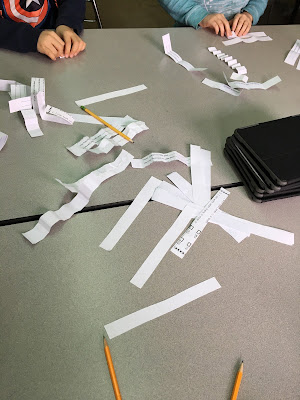
Wait, that just looks like strips of paper ?! Yep, that's what it is. Introducing my FAVORITE fraction manipulative. No need for fancy plastic fraction tiles, no purchase order necessary, no app to download. Just find some paper and cut it in strips. It can even be "GOOSe" paper (good on one side), as in scrap paper ! Here's why I love it: 1) It makes fractions visual . 2) It relates to tape diagrams. 3) It helps make connections of where fractions go on the number line. 4) It's a manipulative that won't expire. It always works, even when students start exploring decimals and percents. 5) It's fun! I have done this lesson with lots of kids over the years. It works great with grades 4-6.  Here's the procedure: 1) Put a lot of strips of paper out! (you want kids to have access to extra in case they "mess up") 2) Have students start with 1 strip and fold into halves. This is usually accessible for ...

Post-It Geometry Challenge

Image
This activity is a fun investigation into symmetry. However, you don't have to wait until you are explicitly teaching geometry or symmetry. It encourages students to be precise and persevere in problem solving. Use it to help address those Standards for Mathematical Practice ! I think 4th grade and up would enjoy a few of these challenges. I've tried it with middle schoolers (6-8) as well as adults. I love the fact that this is an opportunity for all learners to engage in math at the same time. It might even be an opportunity for students that don't find as much success in math class to excel. Here's how it works: 1. Put the picture of the post it notes with holes in it. 2. Students are challenged to take a post-it note and try to fold it so that with 1 single punch with a hole punch it will create this when opened back up. I suggest showing this image first: This one requires a simple fold of the post-it in half.  Walk through how...

Criteria for Choosing Tech Tools

Image
I LOVE USING TECH TOOLS. Let me be clear that I don't like using tech just for tech's sake. Instruction first. Always. Also, focus on the learning. I heard someone say "there is no app for good pedagogy." So true. So, with all those disclaimers, why do I love using technology? Well, it's important, relevant, and honestly can redefine your classroom and the learning for students. I love this quote from NCTM's Principles to Actions : The word essential really stands out to me in this quote. Technology isn't something you can ignore or deny. It's an essential part of our students' world and we need to embrace that. But we all know that there is amazing tech tools and some not-so-great stuff out there. How can you decide what to use? When it comes to using technology in the math classroom, I find using it for students to do practice/formative assessment is most powerful. If I can see their thinking, in the moment, and give feedback it ca...

Math Friends Ask: What is ISTE?

Image
I went to ISTE last week and I felt like I was cheating on my math friends. WHAT IS ISTE? First, ISTE stands for International Society for Technology in Education. They have a big annual conference every summer. This year it was in San Antonio and I was lucky enough to get to present and attend. If you have never heard of ISTE, you aren't alone. Despite the fact that this conference is HUGE, many educators don't even know it exists. (I didn't until a few years ago.) And I saw on Twitter a few math educator friends asking what #ISTE17 stood for because they were seeing it in their newsfeed. And, to make it even harder, I looked at ISTE's website and had to dig a bit to even find it all spelled out! So, why hadn't I heard of ISTE until recently? I've connected mostly with the math ed crowd on social media and engage with the fine folks in #MTBoS often. I just don't hear much about tech stuff as it relates to math... with the big exception being fo...

Using Desmos with Primary Students!

Image
Like so many math teachers , I LOVE Desmos! I tell everyone who will listen that they should be using it. I used it myself when I was in the classroom teaching middle schoolers. The graphing calculator is such a fabulous tool and the Desmos created activities are so engaging and awesome. As I've learned more about activity builder and moved into a K-8 instructional coaching role, I started to think about how it could be used in younger grades. I love the power of card sorts for all levels, so having that option in Desmos really sets it apart from some other platforms that teachers might already be using like ClassKick and Formative (which I love as well!). Recently, I was asked to model a few lessons in classrooms. I started in a 5th grade classroom, and it seemed like a good fit to use Desmos as part of an activity. I included a card sort as well as some open response questions. It went well! Next, I was headed to a 1st grade classroom. They were learning ...

Small Changes that Make a Big Impact!

Image
I love the NCTM article, Never Say Anything A Kid Can Say,  by Steven Reinhart. I reread it often and it always reminds me of something to work on or try so that I can have a more student-centered math class. I have recently been sharing 3 of my favorite tips from the article at PD in my district. These three tips are small changes that you can make that have a BIG impact on your classroom. I vlogged about those three ideas. Enjoy! ;)

Mistakes are Gifts!

Image
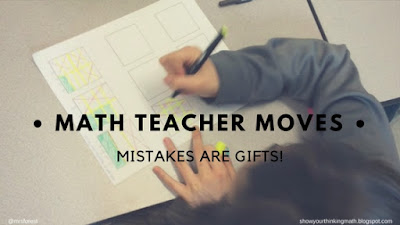
Mistakes aren't just okay , they are gifts ! Six years ago, I was attending some amazing professional development as part of the West Cook Math Initiative- now called Metro Chicago Math Initiative . We had a frequent guest facilitator, David Foster , leading us in a math talk and then discussing re-engagement lessons. I will never forget the day that he said, "Mistakes are gifts." In fact, I believe he said he had heard this from a teacher in Japan that was explaining the role that mistakes can play in helping students understanding mathematical concepts. Bottom line, I don't know who to give credit to for this quote, but it certainly has had an impact on me. It is something that I repeat to students that I teach, teachers that I coach, and participants in professional development that I lead. I just can't say it enough! Here's my vlog of my reflections on this idea: If you like the idea of using mistakes in your classroom, consider re-engage...

Teacher Move: Strategic Eavesdropping

Image
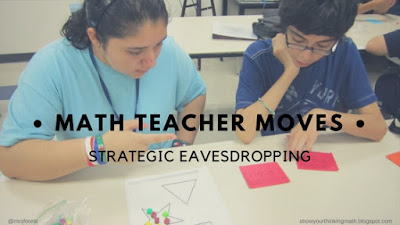
This is my first attempt at "vlogging." It's blogging but with video! This is pushing me out of my comfort zone a bit because, as most people, I hate seeing myself on video or hearing myself talk!! And look how my face is frozen in a weird way on the video below. Ugh! But I think this is a powerful way to reflect on my practice and share ideas I've done in the classroom, so I'm giving it a try. I hope you find this idea helpful. I call it "strategic eavesdropping." It is a teacher move that you do in the classroom as students are working or discussing. You do this to find students work/thinking to share to the group and facilitate class discussions. It is probably something that you are doing already! What makes this a little different than just walking around and listening to kids talk is the  strategic part. You are going to use what you overhear to plan, in the moment, for how to reveal student thinking to the group. Give this video a watch and ...

Ideas for Differentiation in Math Class

Image
Differentiation. I probably don't need to say this, because you already know, but I want to acknowledge just how tricky differentiation can be. There are several reasons: 1. Different kids need different things 2. Different kids like different things 3. Not everyone has the same background knowledge 4. Everyone has different misconceptions or misunderstandings With all of these factors, in each kid, there is actually no way that two kids can be alike! Each kid is unique in their way or learning and seeing the world! There are infinite combinations in how those above factors play out in kids brains. How amazing ! But also, how hard  for teachers! No two kids are alike, but somehow we are supposed to differentiate?? Teachers ask me all the time, "Annie, I know you aren't a fan of tracking , but then how do we reach our top kids? Or struggling kids?" Here's the thing, even if we did have "tracking" and kids were perfectly placed...

Why I Don't Use Keywords (or CUBES)

Image
Teacher confession time: I used to teach my students about keywords in math class. I did not create this poster, but I could have. In fact I had one very similar hanging in my classroom from 2007-2012. I even wrote one of my National Board portfolio entries about a lesson designed around keywords ! This brings be to CUBES. A problem solving strategy I've seen quite a few times in classrooms. I never used it, but mostly because I didn't hear about it. I probably would have been all over that. If you aren't familiar, here is the strategy: C- circle the numbers U- underline the question B- box the keywords, or math action words E- evaluate the steps you should take S- solve and check You might be wondering why I stopped using keywords in math class in 2012. Honestly, I was pretty stubborn. I mean, kids  got the right answers  when I taught key words! I thought I was helping them. Students liked them. Parents understood them. There are actually several reasons I...

Free Apps I Use in the Math Classroom

Image
There are SO many great ways to use iPads in the classroom. However, it can be a little overwhelming! Last year was my first year using iPads in math class. I tried a lot and learned a lot along the way. One big lesson I learned is that there are many math "games" out there that aren't much more than digital flashcards. In addition, many are timed which I think adds a lot of stress and not much in the way of getting students to think mathematically.  Read Tracy Zager's criteria for fact-based apps . If you are new to iPads, or just looking for some new apps, wanted to share some of my favorites. Many of the best apps I found are free! First, if you teach middle school or high school, you NEED Desmos . Download it now and read more about Sara's love of Desmos . Although the activities aren't through the app, also take some time to check out the activities at teacher.desmos.com . Next, check out ClassKick . You create assignments, kids work, yo...