Posts

Showing posts with the label classroom management

The Low Kids and The High Kids

Image
Teaching is challenging and personal and important work. Every teacher I work with is doing their best, want to do their best, and do all of this with a kind teacher heart. I love teachers, in fact I still identify as a teacher myself. When people ask what I do, I say I'm a teacher. Because even if I'm a coach or a math coordinator, at the center of my work is teaching. I was in the classroom for 12 years. I know the difficulties of having a diverse group of learners in one class. The range of understanding on any given topic can be overwhelming to navigate. Am I challenging everyone enough? Is this too challenging? Are kids bored? Are kids checked-out? Are they learning? These are real questions and fears we all have. And sometimes, being in this work means we develop some short-cut ways of describing the complexity of what we see in front of us. It's normal and natural as humans to look for patterns in our experience and categorize things. If we didn't our br...

Finding HAPPY: Efficiency, Productivity, and Avoiding Teacher Burnout

Image
Dusting off the old blog. How is it possible that I haven't blogged since October?! I've missed you! Lately I've been thinking a lot about how to help with a common phrase I hear in education: "One more thing." As in, "this new ( initiative/idea/curriculum/app ) is just one more thing I have to worry about in my classroom." And I get it! With the rate of new initiatives/ideas/curriculums/apps coming across my desk, it's a dizzying pace of new and change. But I also like a lot of these new ideas.  I often present to teachers about these ideas!  So, in my role of instructional coach, how can I help teachers embrace them too without feeling overwhelmed or burning out. First, I think we need to look at the ideas of happiness and success. In this Ted Talk by Shawn Achor, he looks into the idea that being happy makes us more productive. Often, we might think that success will lead to happiness, but this is backwards. And, in fa...

60 Minute Math Block Planning

Image
Recently I wrote a post about planning an 90-minute middle school block . Since then, I've been asked to think about ideas for teaching a 60-minute block in elementary school. I came up with 5 ideas for ways to structure 60-minutes of time with 1st-5th grade students. Think of these as recipes. A starting point. Something you can try as is, and then, as you get more comfortable, move around and adapt to your needs and the needs of your students. I don't know if you like to cook, but it is one of my favorite hobbies. I love trying new recipes. For me, I try the recipe as suggested for the first few times. Once I get comfortable, I might substitute in some herbs. Maybe I change out other ingredients or move things around. It's the same idea for these structures! Option 1: This first idea is based on the 5 E's model : Engage, Explore, Explain, Elaborate, Evaluate. I love this model for encouraging exploration and being true to the constructivist philosophy...

Criteria for Choosing Tech Tools

Image
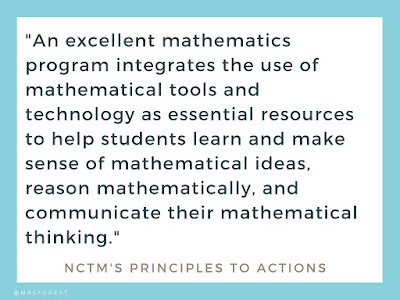
I LOVE USING TECH TOOLS. Let me be clear that I don't like using tech just for tech's sake. Instruction first. Always. Also, focus on the learning. I heard someone say "there is no app for good pedagogy." So true. So, with all those disclaimers, why do I love using technology? Well, it's important, relevant, and honestly can redefine your classroom and the learning for students. I love this quote from NCTM's Principles to Actions : The word essential really stands out to me in this quote. Technology isn't something you can ignore or deny. It's an essential part of our students' world and we need to embrace that. But we all know that there is amazing tech tools and some not-so-great stuff out there. How can you decide what to use? When it comes to using technology in the math classroom, I find using it for students to do practice/formative assessment is most powerful. If I can see their thinking, in the moment, and give feedback it ca...

Back to School: What to Change? What to Keep?

Image
IT'S HERE!!! If you are like me, you feel a little sad about the end of summer but also super excited for a new school year. I love the new school supplies, fresh start, classroom decorating , meeting new kids, and a chance to try new things! I wanted to put together a post that compiled all of my favorite past posts related to stuff teachers think about at the start of a new school year. First, I like to sit down and write out my goals . I think about what I want to keep and what I might want to change . There are several things that you might have done in the past that you might want to rethink. For example, grading , getting rid of your teacher desk , or even how you speak about gender in your classroom . How are you going to arrange your classroom? How will you make seating charts that encourage collaboration ? Think about small changes you could make that will have a big impact. Here are a few . Think about how you might want to treat mistakes in your clas...

The Perfect Student Seating Arrangement?

Image
This is a strange time of year to be writing about seating charts... I mean, it's almost the end of the school year! No one is making seating charts right now. ...or, is it that strange ? This is the time of year that is perfect for reflection . Thinking about what went well and what you want to change for next year. This actually might be the perfect time as you are thinking about how you might want to set up your room for next year! So, what are you thinking about trying for seating next year? Are you a desks in rows kind of person? Pods? Partners? Do you have a rug where kids come for math talks? Do you want to try flexible seating ? No assigned seats? Randomly selected partners? Carefully chosen groups? There are SO MANY choices and decisions to make when it comes to classroom environment and seating arrangements. I wanted to share something I tried with my middle school students. If I had a class of my own again next year, it is what I would be doing. Now, it's ...

Planning for Next School Year

Image
It's that time of year! The end of the school year! When I was a classroom teacher, it was a complicated time. I'm was feeling a little sad about ending my time with a current group of kids. I was also looking forward to quality time with my own family during the summer. But I was also using it as a time of reflection and looking forward. I would start asking myself a lot of questions: What went well this year? What do I keep, what do I change? What are my goals for next year? What new things do I want to try?  This reflection and planning is important. Of course, I fully advocate for teaching right up until the end. Keep it mathy! I blogged about some ideas to use during these last few weeks . But, as you wind down the year, while things are still fresh in your mind, write down some goals or plan for next year. Then, when it's August and you are refreshed and ready to get back to it , you have something to revisit and help you remember what changes you wanted to ...

Teacher Move: Strategic Eavesdropping

Image
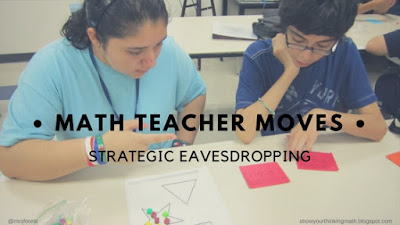
This is my first attempt at "vlogging." It's blogging but with video! This is pushing me out of my comfort zone a bit because, as most people, I hate seeing myself on video or hearing myself talk!! And look how my face is frozen in a weird way on the video below. Ugh! But I think this is a powerful way to reflect on my practice and share ideas I've done in the classroom, so I'm giving it a try. I hope you find this idea helpful. I call it "strategic eavesdropping." It is a teacher move that you do in the classroom as students are working or discussing. You do this to find students work/thinking to share to the group and facilitate class discussions. It is probably something that you are doing already! What makes this a little different than just walking around and listening to kids talk is the  strategic part. You are going to use what you overhear to plan, in the moment, for how to reveal student thinking to the group. Give this video a watch and ...

Block Schedule Planning

Image
I had an opportunity to teach on a 45-minute traditional class period schedule and a 90-minute block. Both models have their pros and cons. I think my own preference is block schedules because you have so much more time to dive into content. There are fewer transitions and it just seems calmer and more conducive to learning. However, one major challenge is finding purposeful ways to fill that block. If you notice that you are doing one activity for a long period of time, it might be important to think about chunking. What I mean by chunking is thinking of you period in 15-20 minute chunks of time and planning activities within those chunks. I find it's difficult to keep students attention if something lasts longer than 20 minutes, so that was my maximum for any activity (except an assessment). I developed the following sample block plans based on 85 minutes. So, if you have 60 minutes you can think about cutting out one of these pieces. If you teach 90 minutes, add 5 minute...

Week-Before-Winter-Break Math Game

Image
There are days leading up to break when you want to do something: 1. "mathy" 2. low-tech 3. fun 4. engaging that will keep everyone's attention! It's that time of year when teachers need a math game idea. My post about  activities to do the last weeks of school  is one of my most viewed because of this exact thing. I wrote about this game, "Draw 10", in the post I mentioned above, but I don't think it got much attention, probably because I didn't explain it well or give examples of how it will look as you play it, so I wanted to fix that. This game is fun for grade levels 3-12. With younger kids you will want to play the whole numbers version, while older students will be more challenged by the decimal version. ((Speaking of older kids, it would be really interesting if someone adapted this into another base besides base-10!)) To play Draw 10 you will need: 1. The game boards printed for your students. I usually try to fit quite a f...

Ideas for Differentiation in Math Class

Image
Differentiation. I probably don't need to say this, because you already know, but I want to acknowledge just how tricky differentiation can be. There are several reasons: 1. Different kids need different things 2. Different kids like different things 3. Not everyone has the same background knowledge 4. Everyone has different misconceptions or misunderstandings With all of these factors, in each kid, there is actually no way that two kids can be alike! Each kid is unique in their way or learning and seeing the world! There are infinite combinations in how those above factors play out in kids brains. How amazing ! But also, how hard  for teachers! No two kids are alike, but somehow we are supposed to differentiate?? Teachers ask me all the time, "Annie, I know you aren't a fan of tracking , but then how do we reach our top kids? Or struggling kids?" Here's the thing, even if we did have "tracking" and kids were perfectly placed...